
Scan a File for Malware and Viruses
Upload a file up to 64 MB and get a verdict from signature matching, structural analysis and behavioural heuristics: Hidden executables, Office macros, PDF JavaScript, double extensions, archive bombs and more. Files are analysed in memory and never stored.
We never execute the file. A clean result means none of our indicators fired, not a guarantee. How to judge a file
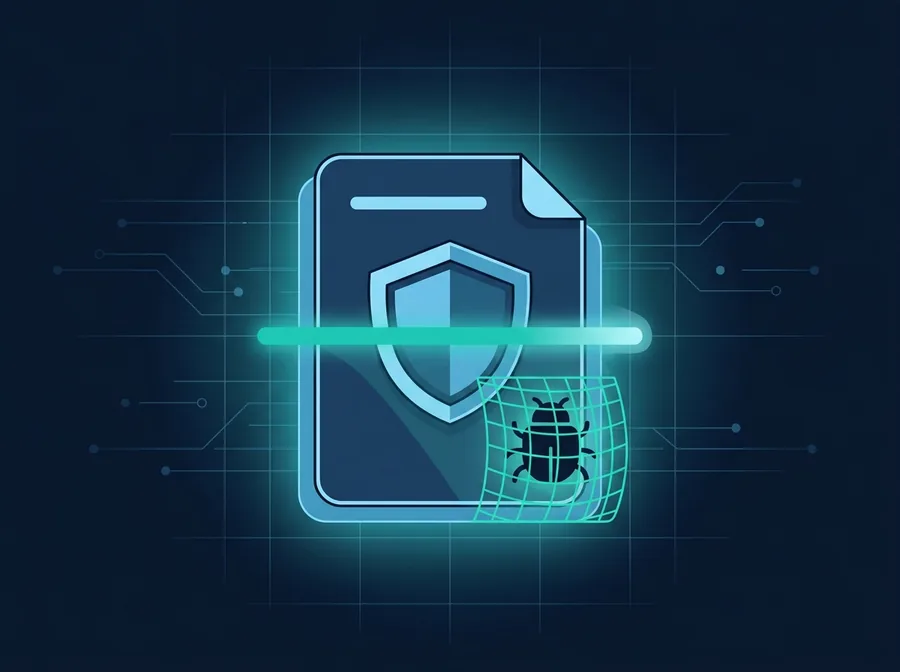
What this tool checks
20 checks across 1 areas. Each links to its reference page with the test, the risk and the fix.
File structure and malware indicators
20 checksThe ones that most often decide the grade:
Guides for this tool
Background reading written to go with these results.
 12 min read · Updated Sep 11, 2026
Malware and File Scanning: How Scanners Detect Viruses, Trojans and Malicious Documents
12 min read · Updated Sep 11, 2026
Malware and File Scanning: How Scanners Detect Viruses, Trojans and Malicious Documents
A file scanner looks for known malware by signature, for suspicious structure such as macros and embedded scripts, and for behaviour...
Read the guide 8 min read · Updated Sep 16, 2026
Is This File Safe? A Step-by-Step Way to Judge a File Before Opening It
8 min read · Updated Sep 16, 2026
Is This File Safe? A Step-by-Step Way to Judge a File Before Opening It
You have a file and you are not sure. This guide gives an order of checks: Where it came from, its real type, its hash, a scan, and the...
Read the guide 8 min read · Updated Sep 02, 2026
How Antivirus and Malware Scanning Actually Works
8 min read · Updated Sep 02, 2026
How Antivirus and Malware Scanning Actually Works
A scanner decides whether a file is malicious by matching known signatures, analysing structure, emulating behaviour and consulting...
Read the guide 8 min read · Updated Sep 11, 2026
Malicious PDF Files: How a Document Runs Code and How to Check One
8 min read · Updated Sep 11, 2026
Malicious PDF Files: How a Document Runs Code and How to Check One
PDFs can carry JavaScript, launch actions, embedded files and exploits for the reader itself. The structures attackers use, the signals...
Read the guide 8 min read · Updated Sep 12, 2026
Office Macro Malware: Why 'Enable Content' Is Still the Most Dangerous Button
8 min read · Updated Sep 12, 2026
Office Macro Malware: Why 'Enable Content' Is Still the Most Dangerous Button
Word and Excel macros remain a leading malware delivery method because they run with your privileges. How macro droppers work, the newer...
Read the guide 8 min read · Updated Sep 14, 2026
Archives and Zip Bombs: Why Compressed Files Need Their Own Scan
8 min read · Updated Sep 14, 2026
Archives and Zip Bombs: Why Compressed Files Need Their Own Scan
Archives hide malware from casual inspection, can be password-protected to defeat scanners and can expand to terabytes to crash them....
Read the guideFrequently asked questions
Do you keep my file?
No. It is analysed in memory and discarded. Only the SHA-256 hash and the verdict are stored.
Is this a replacement for antivirus?
No. It is a second opinion on one file before you open it. Antivirus watches everything, continuously, including what happens after a file runs.
What is the size limit?
64 MB. Larger files are best hashed locally and the hash checked against a threat-intelligence service.
Why is a clean-looking document flagged?
Documents that contain macros, remote templates, JavaScript or launch actions are flagged because those features are how documents deliver malware, even when this particular file is benign.
Do you check files against malware signatures?
Yes. Every file is checked against a signature database as well as being taken apart structurally, and the report tells you which layers ran. We do not name the engines behind the signature layer, because publishing that tells whoever is writing the next sample exactly what to evade.